


Best Project Management Software for Agencies

 Jul 02,2026
  By Namrata Indalkar
Running an agency means juggling multiple clients, shifting deadlines, and busy teams all at once. The right project management software for agencies can be the difference between smooth delivery and constant firefighting. But with dozens of tools on the market, choosing the best software for agencies isn’t easy most were built for general teams, not the fast-paced, client-driven world you work in.
In this guide, we’ll break down the challenges agencies face, what to look for, how AI project management is changing the game, and why the right software for agencies can completely transform how your team plans, delivers, and gets paid.
Why Agencies Struggle with the Wrong Tools
Most agencies don’t start out with a plan for their tech stack they add a tool whenever a new problem appears. A task app here, a spreadsheet for budgets there, a separate timer for billable hours, a chat app for updates, and yet another platform for HR. Before long, the “system” is a tangle of disconnected apps that don’t talk to each other.
That fragmentation creates real, expensive problems:
- Missed deadlines because updates live in five different places and no one has the full picture.
- Billing leakage when billable hours aren’t logged accurately or invoices slip through the cracks.
- Scope creep that goes unnoticed until a profitable project quietly turns into a loss.
- Team burnout from constant context-switching and status-update meetings that eat into real work.
- No visibility for leadership, who can’t easily see which clients and projects are actually making money.
This is exactly why generic apps fall short and why purpose-built software for agencies matters so much.
The Real Cost of Tool Sprawl
Consider a typical 20-person agency. It might pay for a project tool, a time-tracker, an accounting app, a CRM, a chat platform, and an HR system — six subscriptions, six logins, and six bills every month. On paper each one looks affordable. Together they add up to thousands of dollars a year, plus the hidden cost nobody puts on an invoice: the hours your team loses copying data between them.
Picture a designer who finishes a task in the project tool, logs time in a second app, and then a manager re-enters that data into a spreadsheet to build a client report. The same information is handled three times. Multiply that across every project and every team member, and tool sprawl quietly becomes one of the biggest drains on agency profitability. The money you save by consolidating onto one connected platform is real — but the time you win back is where the biggest return actually lives.
Why Agencies Need Purpose-Built Software
You’re not just tracking tasks — you’re managing client approvals, billable hours, resourcing, and profitability across many projects at once. That’s a fundamentally different job from managing a single internal team, and it needs a tool designed for it.
Purpose-built software for agencies connects the whole workflow: from the first client brief, through delivery, to the final invoice. Instead of stitching together five different tools, your team works from one shared source of truth — everyone sees the same priorities, the same deadlines, and the same numbers. That single view is what turns a chaotic agency into a calm, profitable one.
What to Look for in Software for Agencies
Not every tool is built for client work. The best software for agencies should include the following essentials:
- Client & project management — organize multiple clients and projects side by side, with clear boards, milestones, and priorities so nothing gets buried.
- Time tracking & billing — log billable hours directly against each task and turn them into accurate invoices without switching apps or exporting spreadsheets.
- Resource planning — see who’s overbooked and who has capacity before you commit to a deadline, so you protect both margins and your team’s sanity.
- Collaboration — keep briefs, feedback, files, and conversations attached to the work itself, instead of scattered across email threads and chat channels.
- Reporting & profitability — track project health, utilization, and profit margins in real time, so you spot problems while you can still fix them.
- Scalability — a platform that works for a 5-person studio today and still fits when you’re 100 people.
If a tool covers all of this, you’ve found a genuine agency solution — not a generic app in disguise.
The Rise of AI Project Management
The biggest shift in 2026 is artificial intelligence. Instead of manually chasing updates, agencies now use smart automation to predict delays, auto-prioritize tasks, and surface risks before they blow a deadline. For lean teams, this is a game-changer like adding a project coordinator who never sleeps.
Practical AI features that actually save agency time include automated status summaries (so you can skip the update meeting), smart task prioritization based on deadlines and dependencies, workload balancing that flags an overloaded designer before they burn out, and early-warning alerts when a project is trending over budget. When evaluating project management software for agencies, don’t be dazzled by “AI” as a buzzword look for these concrete, time-saving capabilities that reduce manual work.
Why AmDital Is the Best Software for Agencies
There are plenty of tools that handle pieces of the puzzle. But AmDital was built as an all-in-one software for agencies combining projects, time tracking, HR, finance, sales, and goals in a single platform. That means the work an agency actually does, end to end, lives in one connected place.
Here’s why agencies choose it:
- Everything in one place — projects, timesheets, invoicing, recruitment, and team management, so you stop paying for (and switching between) seven different tools.
- Built-in AI — AmDital’s AI project management helps your team prioritize the right work, balance workloads, and spot bottlenecks early.
- From pitch to payment — a won deal in the sales pipeline flows straight into projects, then into invoices, with nothing falling through the cracks.
- Real profitability visibility — see which clients and projects are actually making money, not just which ones are busy.
- Scales with you — whether you’re a 5-person studio or a 100-person team, it grows with your agency instead of against it.
- Fast to adopt — an intuitive interface means your team is productive in days, not months.
For agencies tired of duct-taping tools together, AmDital delivers the clarity that only true project management software for agencies can provide.
Which Agencies Benefit Most
While almost any client-driven business gains from the right platform, a few types feel the impact fastest:
- Creative & design studios — juggling revisions, approvals, and asset handoffs across many clients, where scattered feedback and lost files cost real hours.
- Digital marketing agencies — running always-on campaigns with tight reporting deadlines, where every hour needs to be tracked and tied back to client ROI.
- Software & development agencies — managing sprints, backlogs, and hiring at the same time, where project and people planning must stay in sync.
- PR, events, and consulting firms — coordinating deliverables, timelines, and billable time against multiple retainers at once.
What these have in common is complexity: multiple clients, multiple deadlines, and money on the line. That’s precisely where a purpose-built platform turns chaos into predictable, profitable delivery.
All-in-One Platform vs Point Solutions
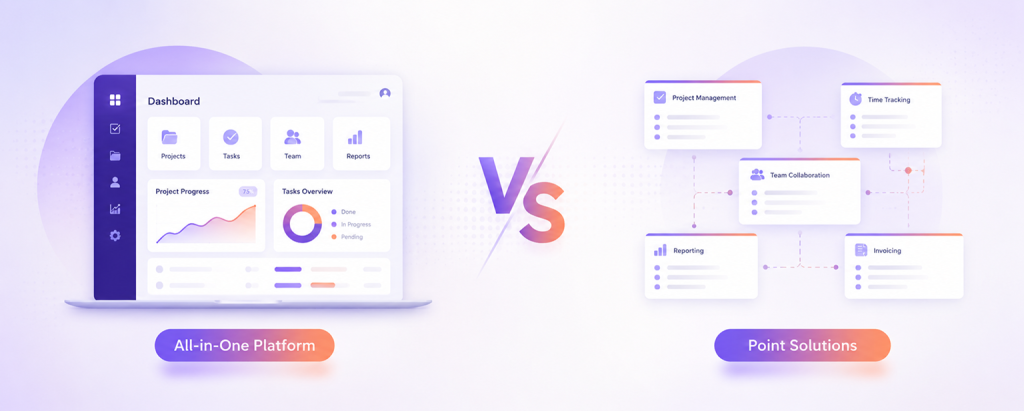
When shopping for software for agencies, you’ll face one core decision: assemble a set of best-in-class point tools, or adopt a single all-in-one platform.
Point solutions can be powerful on their own, but they come with a tax. Every integration is one more thing to maintain, data ends up siloed, and your team pays the “switching cost” of hopping between apps all day. Reporting turns into a manual export-and-merge exercise, and onboarding a new hire means teaching them a whole toolkit before they can be productive.
An all-in-one platform trades a little specialization for a lot of connection. Projects, time, finance, and people data live together, so a change in one place updates everywhere. You get one login, one bill, and one source of truth and reports practically build themselves because the data is already unified.
For most growing agencies, connection wins. The marginal extra features of a specialist tool rarely outweigh the daily friction of a fragmented stack. That’s why more agencies are consolidating onto platforms built to run the entire business, not just one slice of it.
Signs Your Agency Has Outgrown Its Current Tools
Not sure whether it’s time to upgrade? These are the clearest warning signs:
- You spend more time in status meetings than doing the actual work.
- You’ve lost track of which projects are profitable and which are quietly losing money.
- Billable hours regularly slip through the cracks, so revenue leaks every month.
- Onboarding a new hire means walking them through five different logins.
- Important decisions rely on someone digging data out of three separate tools.
- Your team copy-pastes the same information between apps every single day.
If two or more of these sound familiar, your tools are now holding you back and the right platform will pay for itself quickly by recovering lost hours and lost revenue.
How to Choose the Right Tool for Your Agency
With so many options, use this quick framework to decide:
- List your real workflow — map how a project moves from lead to delivery to invoice. Any tool you consider should support that entire journey.
- Count your current tools — add up what you pay across project, time, HR, and finance apps. An all-in-one platform often costs less than the stack it replaces.
- Prioritize adoption — the most powerful tool is useless if your team won’t use it. Favour a clean, simple interface.
- Check that it scales — pick a platform that fits your team now and at three times your size.
- Test with one project — run a real client project through it before rolling out agency-wide.
Making the Switch
Moving to a new platform sounds daunting, but it doesn’t have to be. Start with one team or one client project, import your existing tasks, and expand from there. Bring in a few power users first, let them build the templates and workflows, then onboard everyone else once the structure is in place. Set aside a short window for training, migrate your active projects, and keep the old tools read-only for a few weeks as a safety net. Most agencies are fully running within a week and quickly wonder how they ever managed without it.
Conclusion
Choosing the right agency platform is one of the highest-leverage decisions you can make this year. It’s not just about managing tasks it’s about delivering client work profitably, keeping your team aligned, and scaling without chaos. With built-in AI and everything under one roof, AmDital is the best software for agencies looking to grow smarter in 2026.
👉 Ready to simplify how your agency works? Start free with AmDital today.
Frequently Asked Questions


 Jul 09, 2026

