


7 Signs Your Business Has Outgrown Spreadsheets and Email

 Jul 09,2026
  By Namrata Indalkar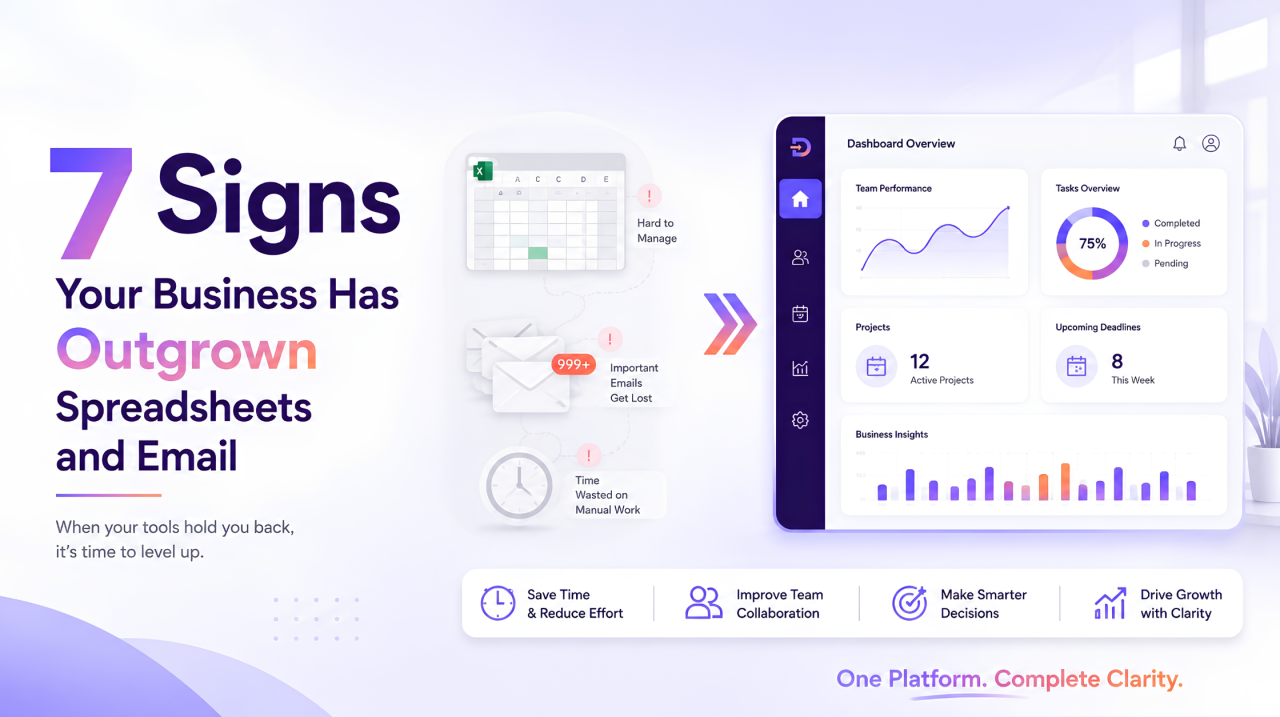
Outgrown spreadsheets and email? It’s a common challenge for growing businesses. While spreadsheets and email are affordable, familiar, and easy to use, they eventually become difficult to manage as projects grow in size and complexity. What once worked well for tracking tasks, sharing updates, and collaborating with a small team can quickly lead to version confusion, missed deadlines, and scattered communication. That’s when project management software for business becomes a smarter solution for keeping work organized and teams aligned.
But as your business grows, these tools often become the biggest obstacle to productivity. Information gets scattered, deadlines are missed, and keeping everyone aligned becomes increasingly difficult.
If your team is spending more time organizing work than actually completing it, it may be time to consider project management software for business.
Here are seven clear signs you’ve outgrown spreadsheets and email and should consider a better way to manage projects.
1. Nobody Knows Which File Is the Latest
Have you ever opened files named:
- Project_Plan_Final.xlsx
- Project_Plan_Final_v2.xlsx
- Project_Plan_Final_Updated_Final.xlsx
Only to realize nobody knows which version is correct?
Version confusion is one of the biggest challenges when teams rely on spreadsheets. Multiple people edit different copies, email attachments get lost, and outdated information leads to costly mistakes.
Modern project management software for business eliminates this problem by maintaining a single source of truth where everyone works with real-time information.
2. Important Updates Get Buried in Email
Email is excellent for communication but it’s not designed for project execution.
Tasks hidden inside long email threads are easy to overlook. Team members forget assignments, conversations become difficult to follow, and accountability disappears.
If your team frequently says:
- “I missed that email.”
- “I thought someone else was handling it.”
- “Can you resend that?”
you’re experiencing one of the biggest signs you need project management software.
Instead of digging through inboxes, project updates should be visible in one centralized workspace.
3. It’s Difficult to Know Who Owns Each Task
As your team grows, verbal updates stop working.
Without clear ownership:
- Tasks get duplicated.
- Responsibilities become unclear.
- Deadlines slip.
- Managers spend hours following up.
While spreadsheets can list assignments, they cannot automatically notify owners, send reminders, or highlight overdue work.
A dedicated project management software for business keeps responsibilities transparent so everyone knows exactly what they’re responsible for.
4.Reporting Takes Too Long
How long does it take to answer questions like:
- What’s the project status?
- Which tasks are overdue?
- What was completed this week?
- Where are the current bottlenecks?
If your answer involves opening multiple spreadsheets, checking email conversations, and manually preparing reports, your workflow isn’t scalable.
Growing organizations need instant visibility.
Instead of manually creating reports every week, modern project management platforms generate dashboards automatically, helping teams make faster decisions.
5. Small Mistakes Are Becoming Costly
Manual processes increase the likelihood of human error.
A simple mistake can include:
- Accidentally deleting rows
- Incorrect formulas
- Copy-paste errors
- Missing task updates
- Working from outdated spreadsheets
As projects become larger, these mistakes affect clients, revenue, and deadlines.
If manual errors are becoming expensive, it’s another indication you’ve outgrown spreadsheets and email.
6. Your Team Uses Too Many Different Tools
Many businesses try solving spreadsheet limitations by adding more applications.
Soon your workflow looks like this:
- Email for communication
- Excel for planning
- Chat applications for updates
- Cloud storage for documents
- Notes apps for meeting minutes
Instead of improving productivity, switching between multiple tools creates confusion.
One of the biggest advantages in the debate around spreadsheets vs project management software is centralization.
Everything from tasks and files to conversations and deadlines—can live in one platform.
7. Growth Feels Harder Than It Should
Growth should improve your business not create operational chaos.
If onboarding new employees takes weeks, project coordination becomes increasingly difficult, and every additional client adds more manual work, your current system is limiting your business.
This is often the strongest indicator of when to switch from spreadsheets to a dedicated project management solution.
The right project management software for business scales with your organization, making collaboration easier instead of more complicated.
Why Businesses Are Moving Beyond Email and Spreadsheets

As organizations grow, managing projects through disconnected tools becomes inefficient.
Choosing to stop managing projects in email doesn’t simply replace one tool with another it transforms how teams collaborate.
Modern project management software offers:
- Centralized task management
- Real-time collaboration
- Automated reminders
- Progress tracking
- File sharing
- Role-based permissions
- Reporting dashboards
- Deadline monitoring
Instead of searching for information, your team can focus on completing meaningful work.
Conclusion
There’s nothing wrong with using spreadsheets and email in the early stages of a business. They’re familiar, accessible, and effective for small teams.
However, every growing business eventually reaches a point where these tools create more work than they save.
If you recognize three or more of these signs, you’ve likely outgrown spreadsheets and email.
Investing in project management software for business isn’t about adding complexity it’s about simplifying collaboration, improving visibility, and giving your team the tools they need to work more efficiently as your business grows.
Frequently Asked Questions


 Jul 07, 2026

