


From Chaos to Structure: Why Modern Teams Need a Single Source of Truth

 Dec 11,2025
  By Akash Mohite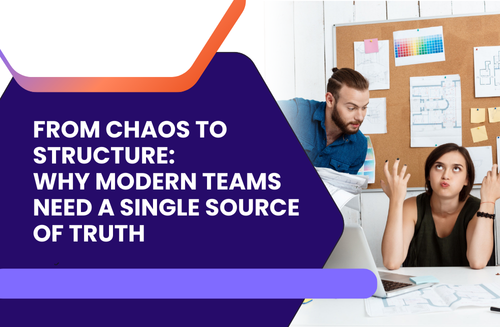
The Daily Reality Leaders Don’t See Until It’s Too Late
There’s a moment that happens in almost every workplace today. A leader asks a simple question Where are we on this project? and the room instantly shifts into quiet panic. Team members begin opening tabs, scrolling through long email threads, checking multiple spreadsheets, jumping between Slack messages, CRMs, drives, and project boards. Someone believes the latest update is in an email from last week. Someone else recalls a revised timeline shared in a meeting. Another insists it was already changed in the project board. And yet, the truth remains unclear.
Even before the answer surfaces, something becomes painfully obvious: the team is operating without a Single Source of Truth. Everyone is trying to piece together fragments from different places, hoping they align. Most days they don’t.
This moment, repeated in work cultures everywhere, illustrates a deeper issue that modern leaders can no longer afford to ignore. The chaos most teams experience daily is not a by product of poor planning or lack of talent. It’s structural. When information lives in too many places, clarity disappears, alignment fades, and productivity quietly deteriorates.
The Hidden Stress Behind Every Workday
Employees today are not exhausted because the work is too difficult they are exhausted because finding the work is too difficult. Before most professionals even begin their day, a significant portion of their mental energy goes into decoding what happened yesterday. They browse through countless messages, revisit old notes, reopen documents, and check different versions of the same file just to understand what’s changed.
This constant searching, verifying, and double-checking creates an invisible mental load that drains energy faster than any task on the to-do list. People feel tired long before they start their actual work. They feel anxious about missing information, stressed about unclear priorities, and overwhelmed by the pressure of keeping up with constant updates.
All of this happens because teams lack a unified place where information stays accurate, updated, and accessible. Without a Single Source of Truth, every message feels urgent, every update feels confusing, and every small task takes longer than necessary. Modern workflow optimization becomes impossible when the foundational clarity is missing.
When Work Doesn’t Live in One Place, Neither Do Teams
As companies scale, the complexity of work doesn’t just increase it multiplies. Different departments adopt different tools, processes get duplicated, and teams become islands operating in partial alignment. Sales works on one version of the metrics. Marketing works on another. Operations depends on a spreadsheet that hasn’t been updated in days. Leadership views dashboards built on outdated data.
The gap between what people think is happening and what is actually happening widens with every new tool added to the workflow. Meetings become the only place to “sync up” because the information outside those meetings cannot be trusted. Employees start relying on memory, personal notes, and informal communication trails, none of which are sustainable.
This fragmentation doesn’t just slow down projects it reshapes the company culture. People spend their days chasing clarity instead of creating progress. Trust erodes subtly because updates differ depending on who you ask. The smallest decisions start feeling heavy because no one is sure which information is accurate.
A Single Source of Truth restores alignment by giving everyone access to the same reality. It replaces uncertainty with confidence and turns disconnected efforts into coordinated movement.
The Financial Impact of Information Chaos
Loss of productivity is not the only consequence of chaotic workflows. There is a direct financial impact that often goes unnoticed until results start declining. Projects get delayed not because the work is difficult but because teams are unsure about the next steps. Opportunities slip away because decision-makers don’t have clear data. Customers receive inconsistent service because internal teams are unsure about updates. Quality drops because workflows lack structure. And employee burnout increases, leading to higher turnover.
Meanwhile, companies end up paying for an ever-growing stack of tools that promise efficiency but deliver more complication. Every new tool creates another silo of information, making alignment harder and workflows more fragmented. The real issue is not the lack of technology it is the absence of a central system where everything connects.
A Single Source of Truth prevents financial leakage by ensuring that teams execute faster, make better decisions, and stay aligned without constant supervision or corrections.
Why Work Is Faster, but Understanding Is Slower
In 2025, teams are busier than ever, yet progress feels slower. The irony is clear: technology has made communication instant, but it has not made understanding easier. Instead, the volume of information has outpaced the organization of information.
People receive hundreds of messages, dozens of updates, and continuous notifications daily, but only a fraction of these translate into meaningful progress. The result is a workplace that feels fast on the surface but slow at its core. Activity increases while clarity decreases.
Modern workflow optimization requires more than speed it requires structure. It requires a system where information flows in one direction instead of many, where updates don’t get lost, and where people don’t spend half the day catching up on what they missed.
A Single Source of Truth creates that structure. It acts as the anchor that stabilizes workflows and brings order to the chaos of digital work environments.
How a Single Source of Truth Transforms the Way Work Happens
The real power of a Single Source of Truth is not in storing information but in unifying it. When tasks, files, updates, deadlines, conversations, and metrics all live in one place, work becomes naturally streamlined. Teams no longer wonder which version is correct or where to find the latest update. They don’t rely on scattered knowledge or informal reminders. Everything becomes transparent, traceable, and accessible.
This transformation changes the rhythm of the workday. People start their day with clarity instead of confusion. Leadership gains real-time insight instead of outdated reports. Collaboration becomes smoother because everyone works from the same foundation. Mistakes reduce because the system provides visibility. And decisions become faster because information is reliable.
A Single Source of Truth doesn’t eliminate complexity it organizes it.
The Emotional Shift: Clarity Creates Confidence
Beyond productivity and efficiency, something deeper changes when teams operate with a Single Source of Truth. The work environment becomes safer. People feel more confident because they aren’t second-guessing themselves. They take more ownership because they understand the bigger picture. They collaborate more openly because they aren’t afraid of working with incomplete information.
Chaos creates anxiety, and anxiety suppresses performance. Clarity creates confidence, and confidence amplifies potential. When teams feel supported by structure not suffocated by it they produce their best work consistently, not occasionally.
A Single Source of Truth becomes more than a tool. It becomes part of the company culture.
The Future Belongs to Teams That Are Structurally Strong
For years, businesses believed that speed, effort, and agility were the keys to success. But 2025 has revealed the real truth: structure is the differentiator. Companies with clear, organized workflows outperform even the busiest teams because consistency beats chaos every single time.
A Single Source of Truth is no longer a technological advantage it is a foundational requirement for modern workflow optimization. It is the system that turns teams into high-performing units. It enables smooth collaboration, fast decision-making, reliable execution, and sustainable growth.
The strongest teams of the future will not be the ones working harder, but the ones working from a shared truth.
Final Reflection: The Power of Shared Truth
Modern teams don’t need more meetings, more tools, more reports, or more pressure. They need alignment. They need clarity. They need a dependable place where the truth lives, evolves, and supports the entire workflow.
A Single Source of Truth gives people the mental space to think, the confidence to act, and the structure to perform their best work. It transforms workplaces from chaotic to coordinated and turns teams from overwhelmed to unstoppable.
When companies move from scattered systems to unified truth, work becomes not only faster but finally meaningful.


 Feb 18, 2026

